Coordinate three inputs
Monitor the main rear feed and both side feeds as they enter the line, establishing a consistent reference for speed and material movement.
Here you’ll find a selection of our work. Explore our projects to learn more about what I do.
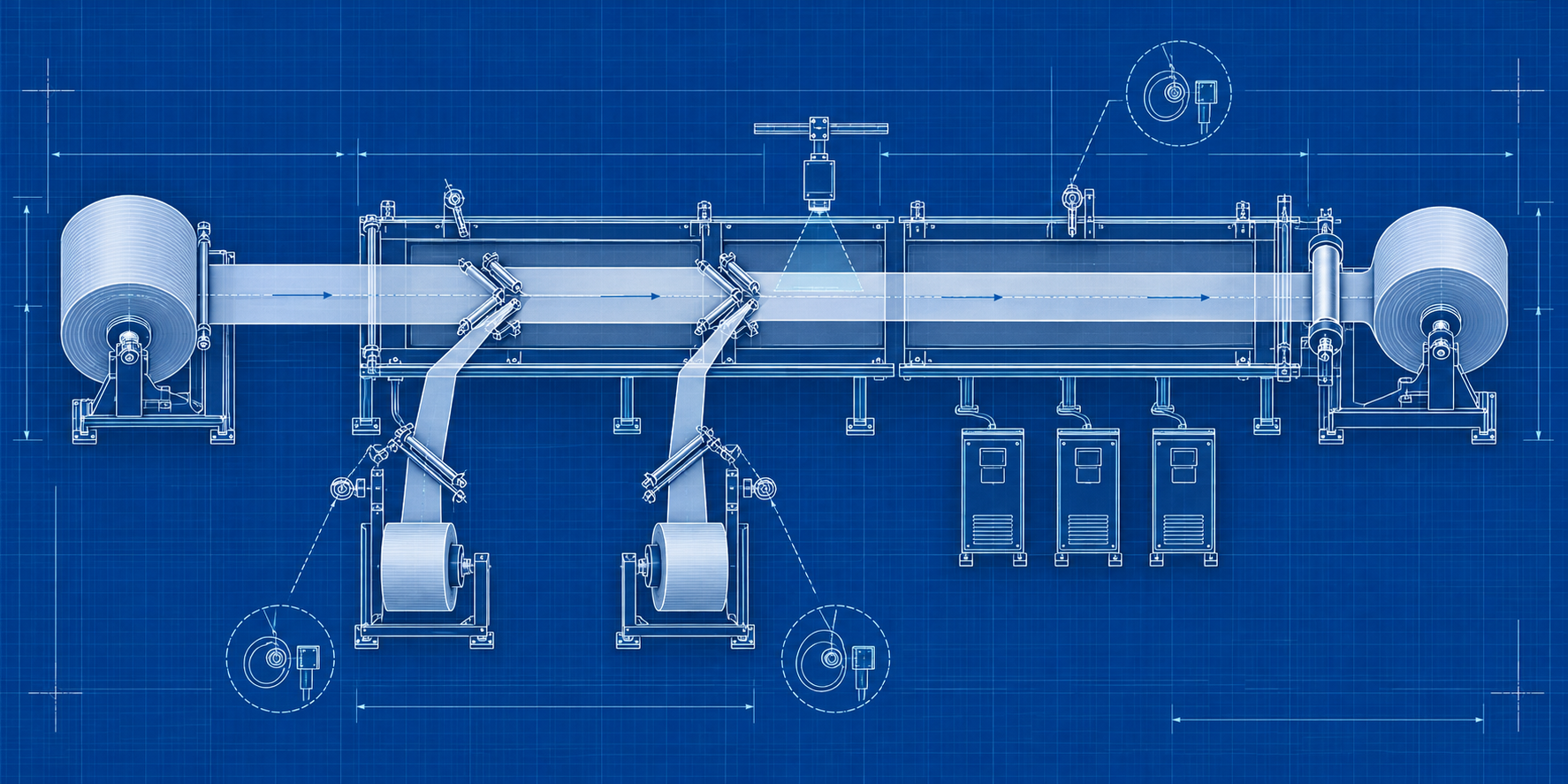
A continuous laminating process depends on more than line speed. Each material has to arrive at the combining point consistently, with tension, position and quality kept within the required limits.
The proposed system creates one practical view of the line: the main web entering from the rear and two additional webs feeding from the sides, all monitored through the critical stages of the process.
The design combines automation, sensing and machine vision so operators can see what is changing before it becomes wasted material or lost production time.
Monitor the main rear feed and both side feeds as they enter the line, establishing a consistent reference for speed and material movement.
Use line-control data to maintain a stable relationship between the webs across the full 10–35 m/min operating range.
Apply inline machine vision and sensing at the useful control points, making alignment and developing defects visible while the line is running.
Earlier warning of feed, alignment or process variation.
Clearer diagnosis by connecting inspection results with line conditions.
Focused improvement based on measured causes rather than assumptions.
Before founding Dacs Labs, Stephen Anderson led industrial drive projects through Proplas International. This installation was published as a Rockwell Automation case study.
Proplas helped a leading European rigid-plastic packaging manufacturer improve large production machines at two UK sites. The customer remained unnamed in the original article.
“The machines were being driven by hydraulic pumps, with their motors set at a constant speed…”
Stephen Anderson · Director, Proplas International
The hydraulic-pump motors ran continuously at fixed speed, including periods when the process required less flow. Allen-Bradley PowerFlex 700 AC drives were installed so motor speed could respond to the machine’s actual demand.
Historical project delivered by Proplas International, with Stephen Anderson serving as Director. It is included here to show the industrial engineering experience that informs Dacs Labs’ work today.
Each solution was developed for a specific production need, combining control, positioning and vision where they added real value.
One centrally mounted laser established a fixed product centreline. Two additional laser line projectors travelled independently to different positions using a servo-controlled system.
The projected lines showed operators exactly where the product should be laid. Stored positions enabled quick size changes without repeated manual measuring and the same approach can be used to provide adjustable guides for trimming applications.
DACS Labs installed a machine-vision facial recognition system to identify the operator using the equipment.
The system connected the recognised operator with machine use, giving the business clearer traceability of who was operating the equipment at the relevant time.